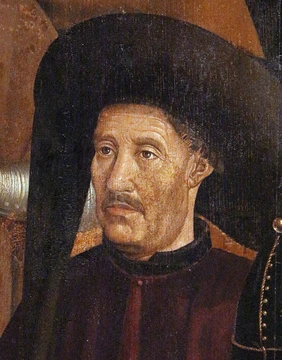
Alonso de Ojeda
Spanish explorer who named Venezuela and led early American expeditions.

Wikipedia / Wikimedia Commons
Alonso de Ojeda (c. 1466 – c. 1515) was a Spanish explorer, governor, and conquistador who participated in the first wave of Spanish conquest in the Americas. He is best known for naming Venezuela during his early expeditions and for being the first European to visit Guyana, Curaçao, Colombia (La Guajira), and Lake Maracaibo.
- born
- c. 1466, Torrejoncillo del Rey, New Castile
- died
- c. 1515
- field
- Exploration, conquest, governance
- nationality
- Spanish
- known_for
- Naming Venezuela; first European to visit Guyana, Curaçao, Colombia (La Guajira), and Lake Maracaibo; founding Santa Cruz (La Guairita)
Lore & Background
Alonso de Ojeda was born around 1466 in Torrejoncillo del Rey, New Castile, to a minor noble father who fought for Queen Isabel. Under her protection, he served the Duke of Medinaceli and distinguished himself in the conquest of Granada with his swordsmanship and bravery. Described as slight, clever, and handsome, he was reputed to always draw first blood in a fight.
Ojeda sailed with Columbus's second fleet in 1493, captaining a ship to Hispaniola. There he led searches for missing men, discovered gold in Cibao, and used a ruse to capture the cacique Caonabo. His brutal punishment of local Indians—cutting off a captive's ears—sparked rebellion. He commanded Spanish forces at the battle of Vega Real and returned to Spain in 1496.
In 1499, commissioned by the Catholic Monarchs, Ojeda sailed with Juan de la Cosa and Amerigo Vespucci to explore the Venezuelan coast. He entered the Gulf of Venezuela, where palafito villages reminded Vespucci of Venice, leading to the name 'Venezuela.' He reached Lake Maracaibo on 24 August 1499 and named Cabo de la Vela. The expedition returned to Hispaniola with pearls, gold, and slaves, but poor returns led to conflict with Columbus's followers.
Reader's Guide
Alonso de Ojeda's significance lies in his role as a pioneering explorer of the South American mainland, particularly the coast of Venezuela. His 1499 voyage, the first detailed reconnaissance of that region, established sustained contact with indigenous peoples and produced the earliest known map of Venezuela, drawn by Juan de la Cosa. Ojeda's naming of Venezuela—whether inspired by Venetian-style stilt houses or a local term—remains a lasting geographical legacy. He also holds the distinction of being the first European to visit Guyana, Curaçao, Colombia (La Guajira), and Lake Maracaibo. However, his legacy is tempered by his harsh treatment of native populations, including mutilation and enslavement, which provoked rebellion and contributed to the chaotic early colonial period. His expeditions, part of the 'minor journeys' after Columbus, expanded Spanish knowledge and claims in the New World, though they yielded limited immediate profit. Ojeda's career exemplifies the blend of exploration, brutality, and ambition that characterized the first wave of Spanish conquistadors.
Did You Know?
- Ojeda cut the ears off a captive cacique after accusing him of theft, shocking local tribes and turning them against the Spanish.
- He captured the cacique Caonabo by convincing him to wear polished brass manacles as a symbol of royalty.
- The name 'Venezuela' may derive from Amerigo Vespucci comparing palafito villages to Venice, or from a local term 'Veneciuela.'
- Ojeda's 1499 expedition included the pilot Juan de la Cosa, who drew the first known map of Venezuela.
Frequently Asked Questions
Who is Alonso de Ojeda?
Alonso de Ojeda was a Spanish conquistador, governor, and explorer born around 1466 in Torrejoncillo del Rey, New Castile. He belongs to the very first generation of Spaniards who pushed into the Americas and carved out colonial claims along the Caribbean and northern South American coasts.
What is Alonso de Ojeda most famous for?
He is best remembered for coining the name "Venezuela" during his early coastal expeditions, a label that stuck and became the modern nation's identity. That single act of naming is the thread most history books tie to his legacy.
Which places was Alonso de Ojeda the first European to visit?
He holds the "first European" distinction for Guyana, Curaçao, the La Guajira peninsula in Colombia, and the shores of Lake Maracaibo. Together those waypoints trace a broad sweep across the northern South American and southern Caribbean coastline.
What colony did Alonso de Ojeda found?
He established the settlement of Santa Cruz, also called La Guairita, on the Venezuelan coast. It stands as one of the earliest Spanish colonial outposts in that part of the New World.
When and where did Alonso de Ojeda die?
He died around 1515, though the precise circumstances and location of his death are not firmly recorded in surviving sources. His life, spanning roughly 1466 to 1515, placed him squarely in the opening decade of sustained Spanish presence in the Americas.
More in Explorers & Navigators 1-24
Elsewhere in the Explorers & Navigators universe
Spotted an error? Know more?
This is a living reference — every entry is fact-audited, and reader corrections feed straight into our audit queue. Suggest an edit · See this site's audit record