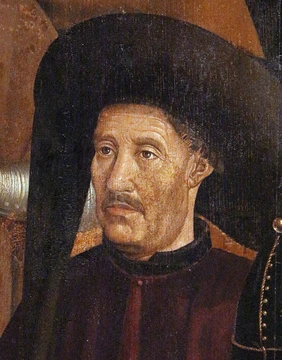
Antonio Pigafetta
Venetian chronicler of Magellan's circumnavigation.
Antonio Pigafetta (c. 1491 – c. 1534) was a Venetian scholar and explorer best known as the chronicler of the first documented circumnavigation of the world, the Spanish expedition to the Spice Islands led by Ferdinand Magellan (1519–1522). His detailed journal, which he kept as Magellan's assistant, is the primary source of information about the voyage and contains the first recorded document of the Cebuano language.
- born
- c. 1491, Vicenza, Italy
- died
- c. 1534
- field
- Exploration, chronicling, linguistics
- nationality
- Venetian (Republic of Venice)
- known_for
- Chronicler of the first circumnavigation of the world; first recorded document of the Cebuano language
Lore & Background
Pigafetta was born to a prominent noble family in Vicenza. His father was Giovanni Pigafetta and his mother Lucia, daughter of Marco Muzan; they married in March 1492, implying Antonio was born after that date. Details of his education are unknown, though he later boasted of having 'read many books'. There is a tradition that as a youth he sailed the Mediterranean with the Knights of Rhodes, but no record exists, only that he later became a member of the order. He entered the service of papal ambassador Francesco Chiericati, a fellow Vicentine and close associate of Pope Leo X. In 1518, Leo X sent Chiericati to Spain as ambassador, and Pigafetta accompanied him to Zaragoza and then Barcelona.
Reader's Guide
Pigafetta's significance lies in his meticulous journal, which is the source for much of what is known about Magellan and Elcano's voyage. He was one of only 18 men to complete the circumnavigation out of approximately 240 who set out. His account, the 'Relazione del primo viaggio intorno al mondo', was distributed to European monarchs in handwritten form and later published (1550–59). It includes the first known use of the word 'Pacific Ocean' on a map. The original document was not preserved, and surviving manuscripts and printed books exist in French and Italian, with philological uncertainty about the original language. Pigafetta's work also contains the first recorded document of the Cebuano language. His legacy is further marked by the naming of the bitypic palm genus Pigafetta and the Italian destroyer Antonio Pigafetta.
Did You Know?
- Pigafetta was one of only 18 men to complete the entire circumnavigation out of about 240 who set out.
- His journal contains the first recorded document of the Cebuano language.
- He was wounded in the Battle of Mactan, where Magellan was killed, but recovered and returned to Spain.
- The original manuscript of his account was lost; surviving copies are in French and Italian, with debate over the original language.
Frequently Asked Questions
Who is Antonio Pigafetta?
Antonio Pigafetta was a Venetian scholar and chronicler who served as assistant to Ferdinand Magellan during the 1519–1522 expedition. He is best remembered as the man who kept the detailed written account of what became the first documented circumnavigation of the globe.
What was Antonio Pigafetta's role on Magellan's expedition?
Pigafetta acted as Magellan's personal assistant and official scribe, recording daily observations of the crew, the lands they encountered, and the languages they heard. His journal remains the single most important primary source we have about the entire voyage.
Why is Antonio Pigafetta's journal historically significant?
Beyond documenting the first full circumnavigation, his notebook contains what scholars recognize as the earliest surviving written record of the Cebuano language. It also preserves vivid descriptions of Pacific islands, local customs, and the hardships the surviving crew endured.
Where and when was Antonio Pigafetta born?
He was born around 1491 in Vicenza, which at the time was part of the Republic of Venice. He is generally believed to have died around 1534, though the exact circumstances of his death remain uncertain.
How does Antonio Pigafetta's legacy differ from Magellan's?
While Magellan is remembered as the expedition's leader, Pigafetta is the one whose words actually survive; without his journal, much of the voyage would be lost to history. Historians and fans often call him the true voice of the circumnavigation because his first-person account forms the backbone of everything we know.
More in Explorers & Navigators 1-24
Elsewhere in the Explorers & Navigators universe
Spotted an error? Know more?
This is a living reference — every entry is fact-audited, and reader corrections feed straight into our audit queue. Suggest an edit · See this site's audit record