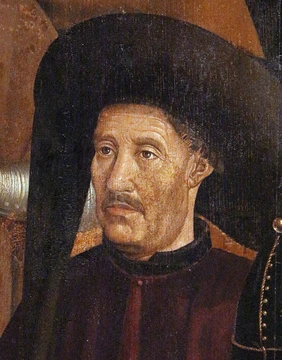
Benjamin Bonneville
American officer and explorer who blazed parts of the Oregon Trail.
Benjamin Louis Eulalie de Bonneville, a French-born American army officer, fur trapper, and explorer, is remembered for his journeys into the Oregon Country and the Great Basin, and for helping to establish sections of the Oregon Trail. His adventures were later popularized in a book by Washington Irving.
Bonneville was born near Paris in 1796 to a French publisher and his wife. When he was seven, his family moved to the United States, with their passage paid by Thomas Paine, who had lived with them in France and was godfather to Benjamin and his two brothers. Paine’s will left most of his estate to Bonneville’s mother, including 100 acres of his New Rochelle farm, so she could raise and educate her sons.
In 1813, Bonneville entered West Point, graduating in just two years as a brevet second lieutenant of light artillery. He served in New England, Mississippi, and Fort Smith in the Arkansas Territory. Promoted to captain in 1824, he was stationed at Fort Gibson in Indian Territory and later, after a trip to France where he was a guest of General Lafayette, transferred to Jefferson Barracks in Missouri in 1828.
Inspired by the writings of Hall J. Kelley and editorials in the *St. Louis Enquirer*, Bonneville sought to explore the West. Kelley appointed him to lead an expedition to the Oregon Country, but a lack of volunteers forced its cancellation. Undeterred, Bonneville petitioned General Alexander Macomb for a 26-month leave of absence, arguing he could gather intelligence among Native Americans in the Oregon Country, then under joint U.S.-British occupation and largely controlled by the Hudson’s Bay Company. Macomb granted the leave from August 1831 to October 1833, instructing Bonneville to pose as a fur trader and collect information on the region’s natural history, climate, geography, and tribes. Private donors, including Alfred Seton and possibly John Jacob Astor, funded the expedition.
Bonneville married and had a daughter, but both died. He did not remarry until after retiring from the army in 1866, when he settled in Fort Smith, Arkansas, and married Sue Neis.
His most notable expedition began in May 1832, when he left Missouri with 110 men, including lieutenants Michael Cerre and Joseph R. Walker. Financed by John Jacob Astor, a rival of the Hudson’s Bay Company, the group traveled from Fort Osage up the Platte River, across present-day Wyomin
- born
- April 14, 1796
- died
- June 12, 1878
- field
- Military officer, fur trapper, explorer
- nationality
- American (born in France)
- known_for
- Expeditions to the Oregon Country and Great Basin; blazing portions of the Oregon Trail
Lore & Background
Benjamin Bonneville was born in or near Paris, France, the son of publisher Nicholas Bonneville and Marguerite Brazier. When he was seven, his family moved to the United States; their passage was paid by Thomas Paine, who had lodged with the Bonnevilles and was godfather to Benjamin and his brothers. Paine left the bulk of his estate to Marguerite, including 100 acres of his New Rochelle farm, so she could maintain and educate her sons. In 1813 Bonneville received an appointment to the United States Military Academy at West Point, graduating after two years as a brevet second lieutenant of light artillery. He served at posts in New England, Mississippi, and Fort Smith in the Arkansas Territory, and was promoted to captain in 1824 while at Fort Gibson in the Indian Territory. After traveling to France as a guest of General Lafayette, he was transferred in 1828 to Jefferson Barracks in Missouri.
Inspired by the writing of Hall J. Kelley and editorials in the St. Louis Enquirer, Bonneville sought to explore the American West. After a planned expedition with Kelley fell through due to lack of volunteers, he petitioned General Alexander Macomb for a leave of absence from the military, arguing he could perform valuable reconnaissance among Native Americans in the Oregon Country. Macomb granted a 26-month leave from August 1831 to October 1833, instructing him to gather information on natural history, climates, soils, geography, topography, mineral production, geology, and the character of local tribes. Expenses were paid by private donors, including Astorian Alfred Seton and possibly John Jacob Astor.
Bonneville's most notable expedition began in May 1832, when he left Missouri with 110 men, financed by John Jacob Astor. They proceeded from Fort Osage up the Platte River, across present-day Wyoming, and reached the Green River in August, where they built a fur trading post called Fort Bonneville (mountain men called it 'Fort Nonsense'). In spring 1833, Bonneville explored along the Snake River in present-day Idaho and sent a party under Joseph R. Walker to explore the Great Salt Lake and find an overland route to California. Walker discovered a route along the Humboldt River and Walker Pass across the Sierra Nevada, later known as the California Trail. Bonneville's attempts to reach Oregon were repeatedly thwarted by Hudson's Bay Company officials who refused to trade with him. He spent the winter of 1834–35 with the Shoshone and returned to Missouri by August 1835, only to find his commission had been revoked.
Reader's Guide
Benjamin Bonneville's significance lies primarily in his exploration of the American West during the early 1830s, particularly his role in blazing portions of the Oregon Trail and his sponsorship of Joseph Walker's expedition, which discovered the California Trail. Though his fur trading venture was commercially unsuccessful—his fort was derided as 'Fort Nonsense' and he failed to trade with the Hudson's Bay Company—his detailed maps and notes, turned over to Washington Irving for $1,000, became the basis for Irving's 1837 book The Adventures of Captain Bonneville. This book made Bonneville famous and helped popularize the American West for eastern audiences. His reconnaissance, conducted under military orders to gather information on geography, climate, and Native tribes, contributed to U.S. knowledge of the Oregon Country and Great Basin during a period of joint occupation with Britain. After his explorations, Bonneville successfully petitioned to have his commission reinstated and served in the Mexican–American War, taking part in the Veracruz campaign and the occupation of Mexico City. He was promoted to colonel of the 3rd Infantry Regiment in 1855 and later settled in Fort Smith, Arkansas, after retiring in 1866. His legacy endures as a figure who bridged military exploration, fur trade, and literary fame.
Did You Know?
- Bonneville's family's passage to the United States was paid by Thomas Paine, who was godfather to Benjamin and his brothers.
- His fur trading post, Fort Bonneville, was called 'Fort Nonsense' by mountain men and was never used for trading.
- Bonneville met Washington Irving through his patron John Jacob Astor and sold his maps and notes to Irving for $1,000.
- Joseph R. Walker, a lieutenant under Bonneville, discovered the route that became the California Trail.
More in Explorers & Navigators 1-24
Elsewhere in the Explorers & Navigators universe
Spotted an error? Know more?
This is a living reference — every entry is fact-audited, and reader corrections feed straight into our audit queue. Suggest an edit · See this site's audit record